The Penny Bun, Askwith
The village of Askwith sits on a country road between Ilkley and Otley. Far enough from either to feel genuinely still. There is a school, a cluster of farms, a village hall, a handful of stone houses and The Penny Bun. The inn has occupied this corner of Wharfedale for the better part of a hundred and fifty years.
Denton Park Estates, which controls the 2,500-acre Denton Reserve stretching from moorland down to the River Wharfe, reopened the building in April 2024. The name belongs to the wild mushrooms that grow in the estate's woods each autumn. The restoration is not cosmetic. It sits within a larger project: the repair of moorland peat, the planting of thousands of trees, the rewilding of land that has been worked hard for a long time.
Inside, the building has been stripped back rather than dressed up. Cork, clay plaster, reclaimed oak. Five bedrooms above, all screen-free. Views south across Wharfedale towards Ilkley Moor. The landscape begins working on you before you have understood what it is doing.
The first thing you notice is what is absent. There is no music. No screen behind the bar cycling a highlights reel. No ambient fill pulling the room towards performance. The inn holds its silence without effort, the way a building does when the decisions made inside it were the right ones.
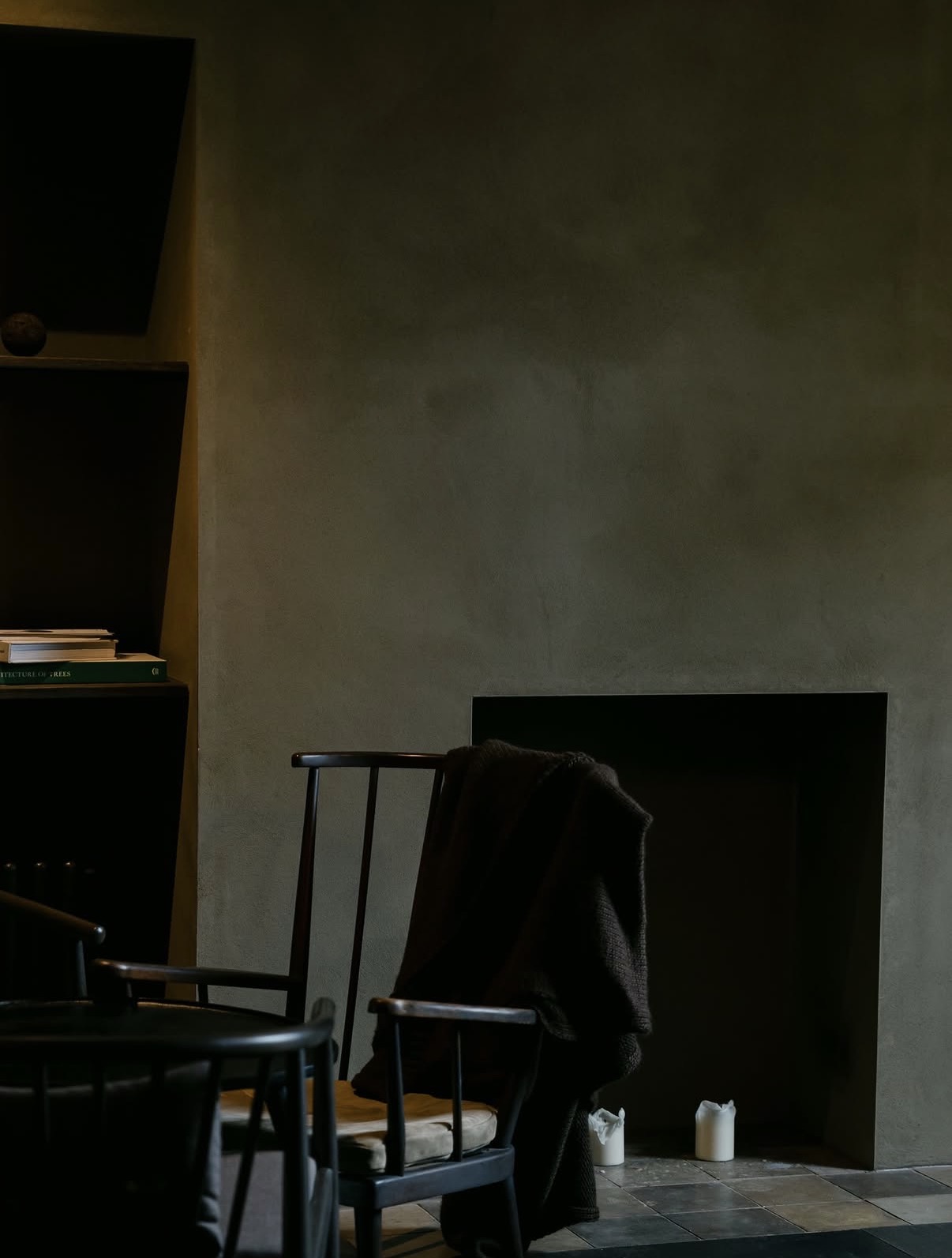
The clay plaster wall behind the fireplace takes up a significant portion of the room. Its surface is not uniform. Colour shifts between pale straw and near-grey depending on where the light falls, and the texture holds a faint record of how it was applied. Beside the unlit hearth, a pair of white candles. A Windsor chair with a dark blanket folded across the back. Books stacked on a shelf in the corner. These things do not ask to be looked at. They are simply present.
The building is gritstone. The same dark, coarse-grained stone used for most of what has been built across this part of Yorkshire for three centuries. It is not decorative. It is what was here, and what the land produced. The restoration has not tried to apologise for it.
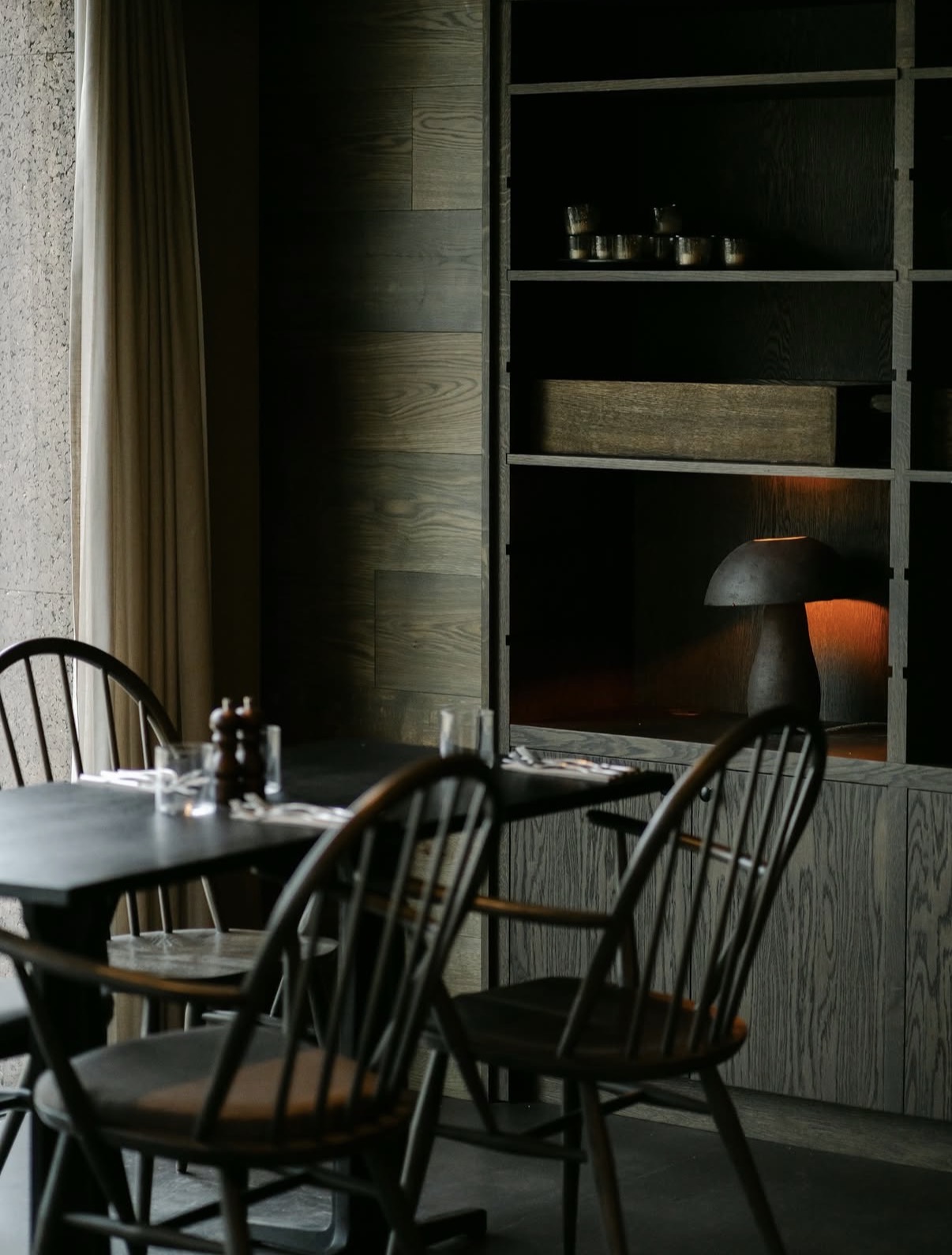
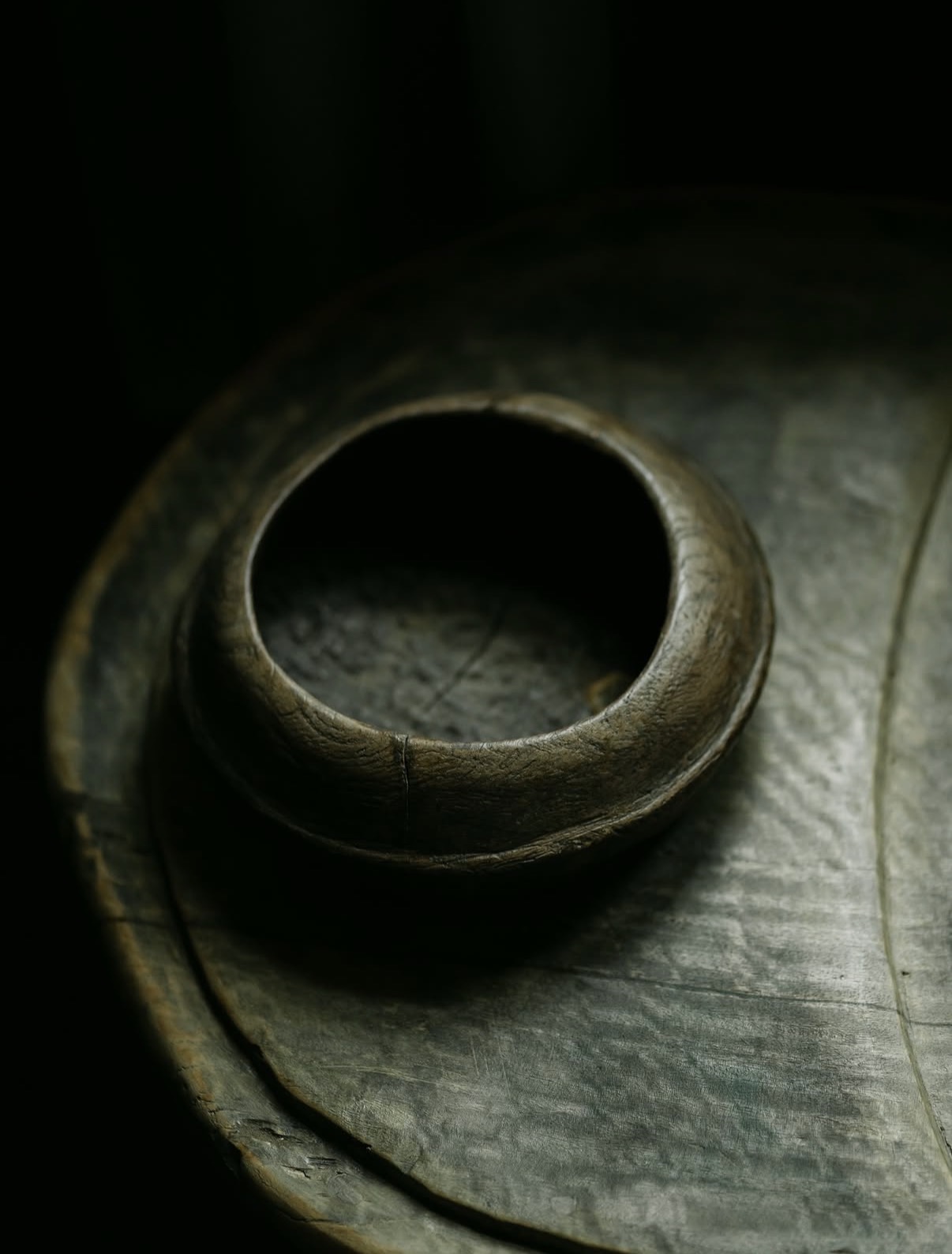
Inside, the grain is everywhere. Reclaimed oak underfoot, worn smooth in older sections and more deliberate where it has been relaid. The dark timber of the shelving unit behind the dining room carries the same logic. Seasoned wood placed with care. The small wooden bowl that appears in the photographs was turned from a single piece of timber, the plate beneath it worn to the same dark tone by use. These are materials with a before. They carry weight not because they are expensive but because time has already worked on them.
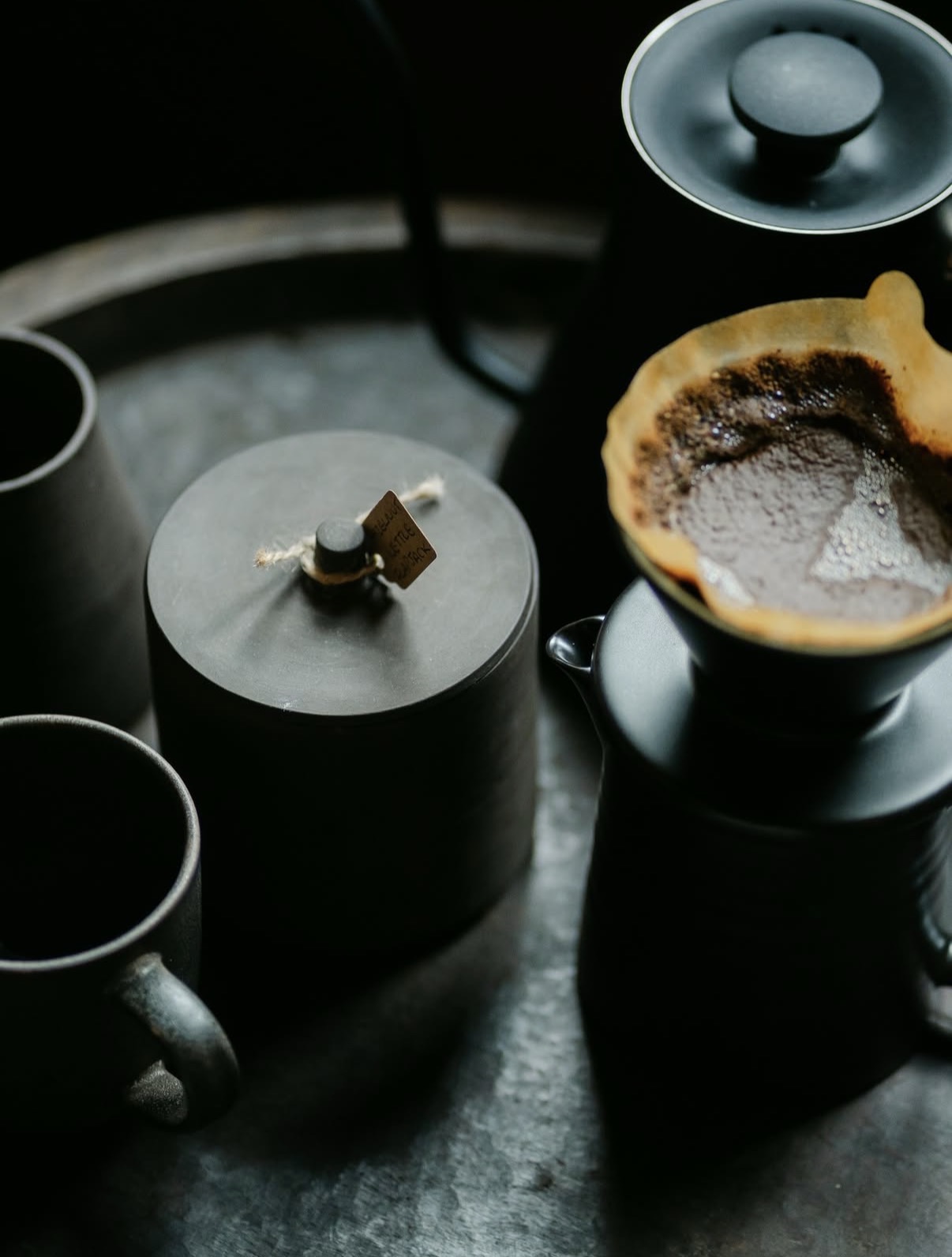
The pour-over arrives on a tray. Dark ceramic cups, a lidded pot, a filter cone still holding the spent grounds. The tray sits on a pewter-coloured surface and the whole thing reads as a composition that no one composed. Someone simply brought coffee.
There is something particular about drinking coffee in a room at this pace. The room slows you before you have decided to slow down. You stay with the cup longer than you planned. You notice the surface of the table. The quality of the light through the window. The sound of nothing very much outside on the lane.
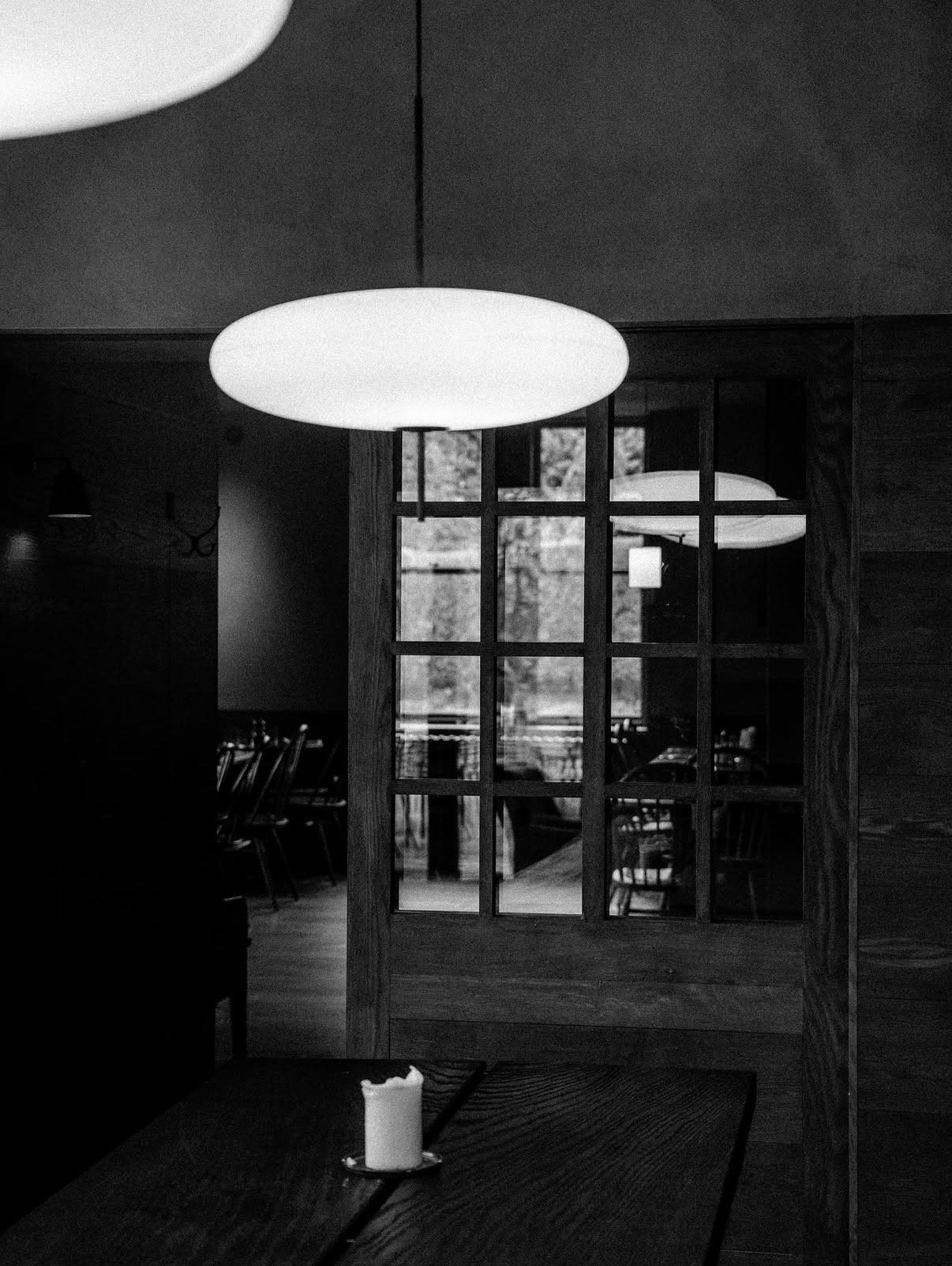
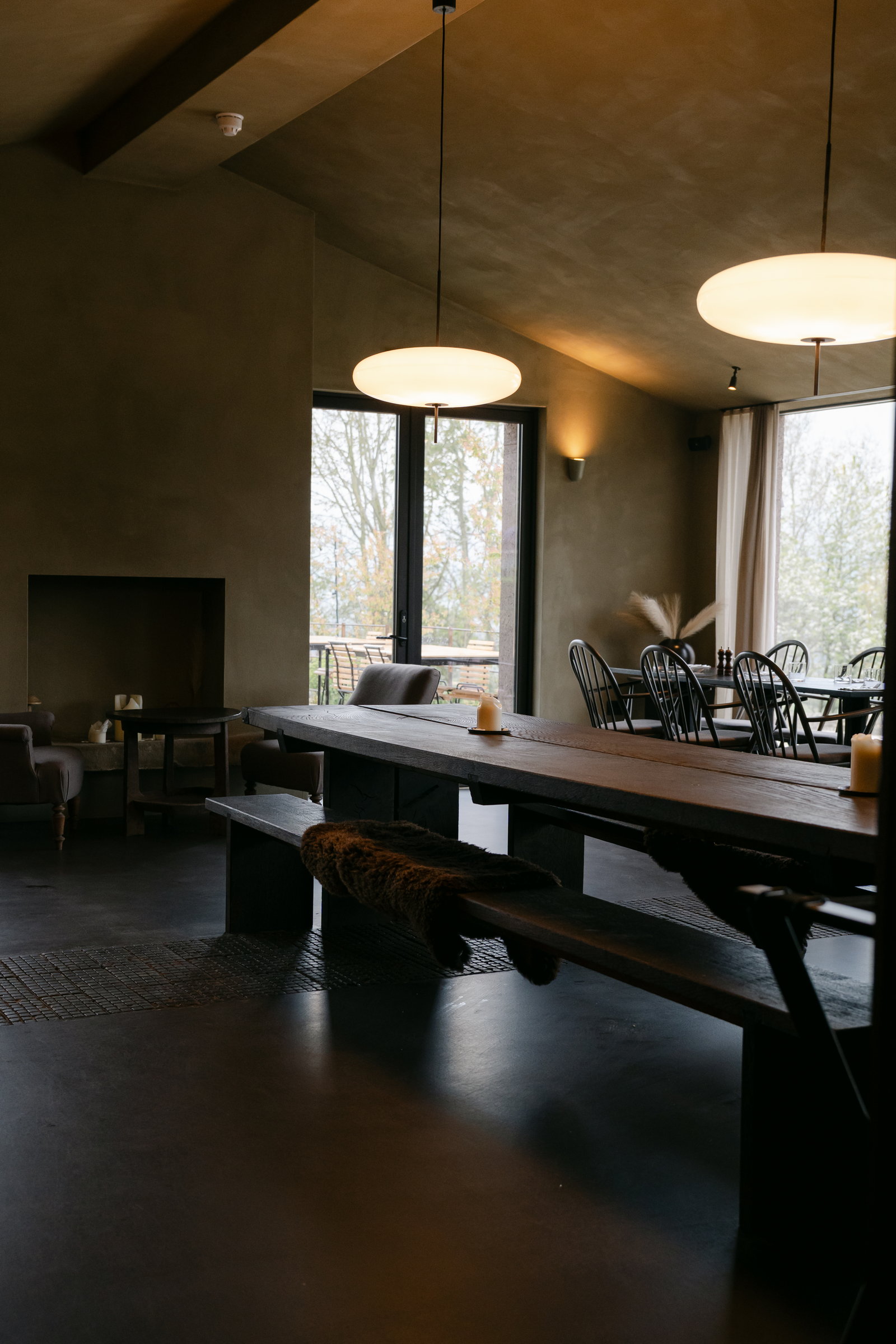
The inn faces south, and the light crosses Wharfedale and enters at angles that change across the day. In the black-and-white frame of the main room, a single globe pendant hangs above the table. A white candle burns on the table surface below it. Through the gridded glazed partition, the room continues into the conservatory and the chairs and pendant lights beyond repeat themselves in the glass, overlapping with the trees outside. The photograph holds three layers of space simultaneously without trying to.
Shadow here is not a problem the room has failed to solve. The depth of the stone reveals, the height of the ceilings, the oak-clad shelf unit that absorbs light rather than reflecting it: these keep the room in productive darkness even in the middle of the day. The mushroom lamp on the lower shelf glows in a warm amber that sits against the grey of the surrounding timber. It is a small source of warmth in a restrained interior, and it reads as enough.
From a seat near the window you can see across the fields to the south. The landscape of Wharfedale at this elevation is wide and unhurried. In the middle distance, drystone walls divide the land into shapes that have not changed much in two centuries. The moor beyond Ilkley is darker, harder, its outline fixed.
The Denton Reserve extends across much of what you can see from inside the building. The restoration work happening across those acres, the planting of sphagnum moss on degraded peat, the leaky dams, the trees going in year by year, none of it is visible from a table. But knowing it is there changes the way you look at the hillside. The landscape is not passive. Something is being repaired out there, slowly and seriously, and the inn is the most visible part of something much larger than itself.
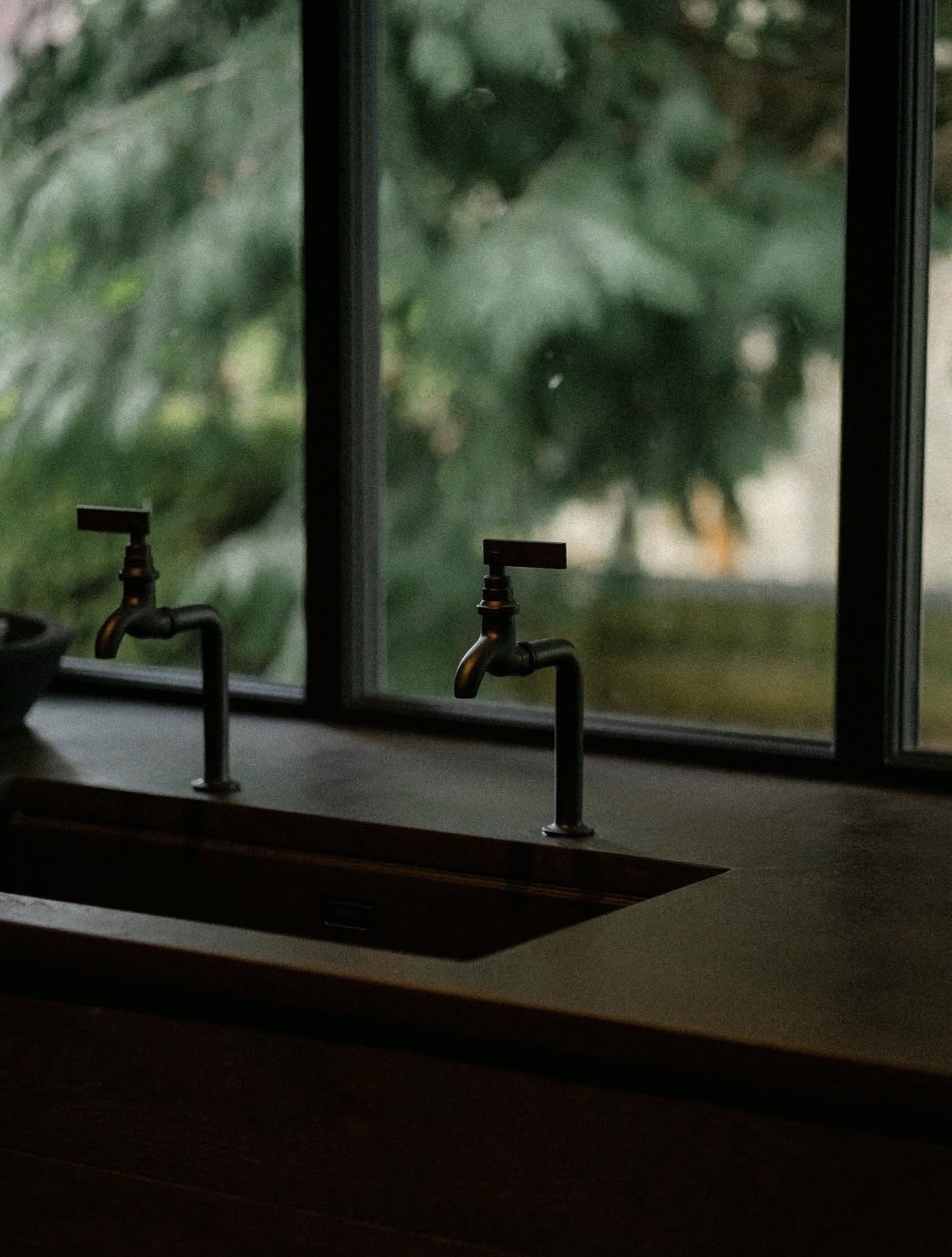
The bronze taps at the bar sink are photographed against the window and the tree outside. Two objects in good proportion. The geometry of the plumbing, the soft green of the canopy in the rain, the dark surface of the stone counter below. The frame needs nothing added to it and nothing taken away.
Askwith wakes quietly. A car on the lane. The school across the road. The fields wet from the night before. From the inn in the early morning the light is thin and horizontal and the glass in the windows holds rain from the previous evening, the trees beyond them blurred green.
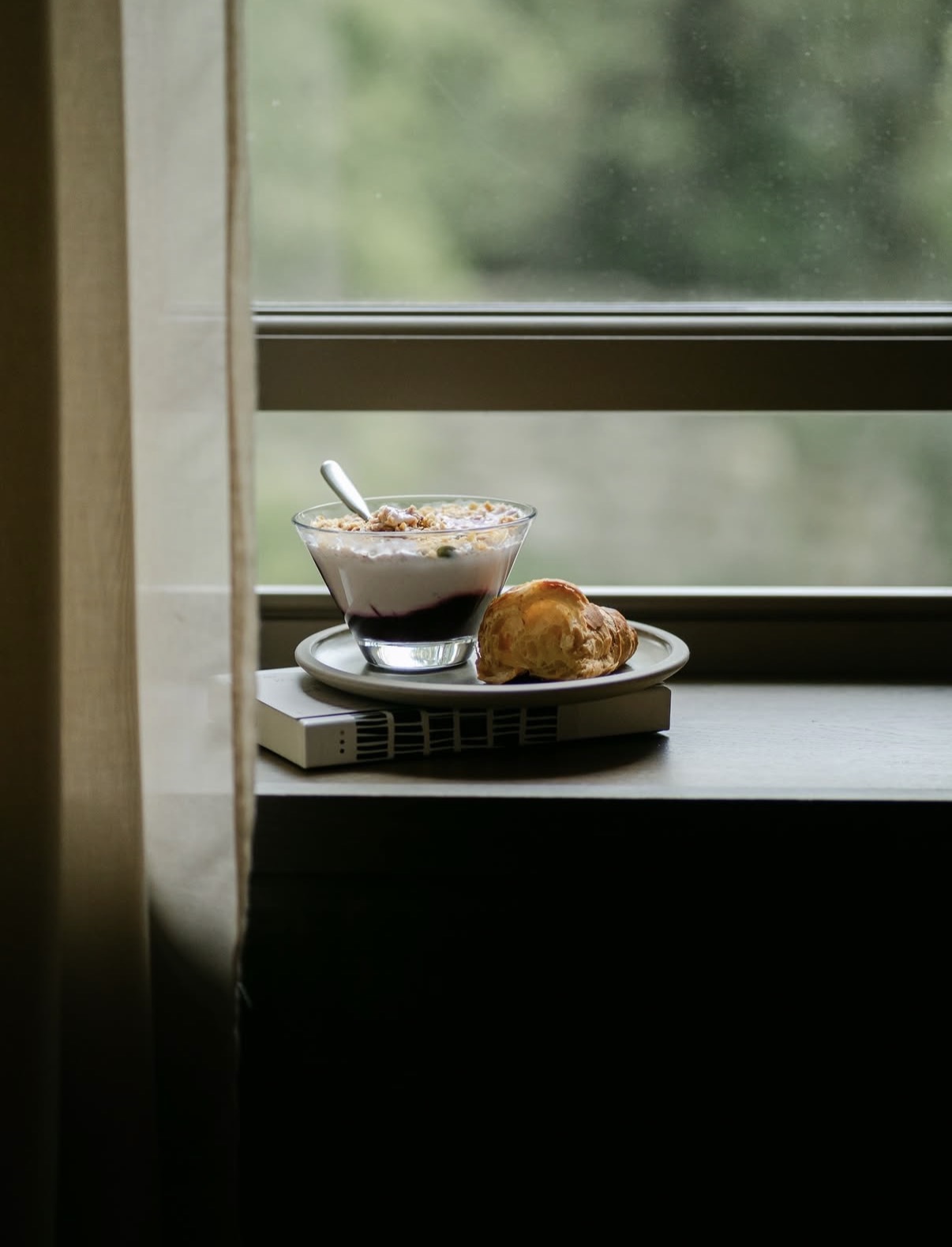
The breakfast image is made on a windowsill. A bowl of yoghurt with berry compote and granola. A croissant on the plate beside it. A small book or card underneath. The window looks out on trees and the particular green of a Yorkshire morning after rain. The plate is pewter-grey. The tray sitting below the plate carries a small rectangular object, a bluetooth speaker perhaps, the only visible piece of technology in the room. The image is ordinary. Someone is about to eat breakfast beside a window and the view is worth looking at.
The Penny Bun is not a difficult place to understand. A farming village on the eastern Pennines. An old building stripped back and put to use again. A landscape being, quietly and seriously, restored. These are plain facts. They are also, when you are inside the building looking out at the valley, they hold.
What stays with you afterwards is not dramatic. It is more like a physical sensation: the particular quality of light in a room that does not manage your attention. The weight of stone. The unhurried pace of a coffee in a space that earns its silence.
There are places that ask you to meet them halfway. The Penny Bun does not ask this. It simply is what it is, and the valley behind it is going on regardless. You were here. The room held you for a while. That is what stays.
The Penny Bun stands in Askwith, a farming village on the road between Ilkley and Otley in Wharfedale, and it is that rare thing: a country inn restored by people who understood that pace is the product. Stone floors, clay plaster, Windsor chairs, open fires, rooms upstairs, and a kitchen serious enough to draw guests over the moor roads in winter. The study was made across a morning, from the empty dining room through the first services of the day.
The photographs concern the inn's material honesty, plaster that shows its hand, timber that shows its age, candlelight used as lighting rather than styling, and the specific quality of a Yorkshire morning arriving through small-paned windows. The sequence moves at the building's own speed, which is the study's actual subject: how a room can enforce slowness through nothing but material and light.
In the archive The Penny Bun holds the Craft category's northern ground and supplies frames to the Journal's essays on material, brass and patina. It is also, with KAAWA and the studio's own Yorkshire base, part of the archive's local spine, evidence that the editorial standard applied to Gulf palaces and Milanese boutiques works identically on a village corner, because the standard was never about the postcode.