Atlantis The Royal
The entrance tells you where you are before anything else.
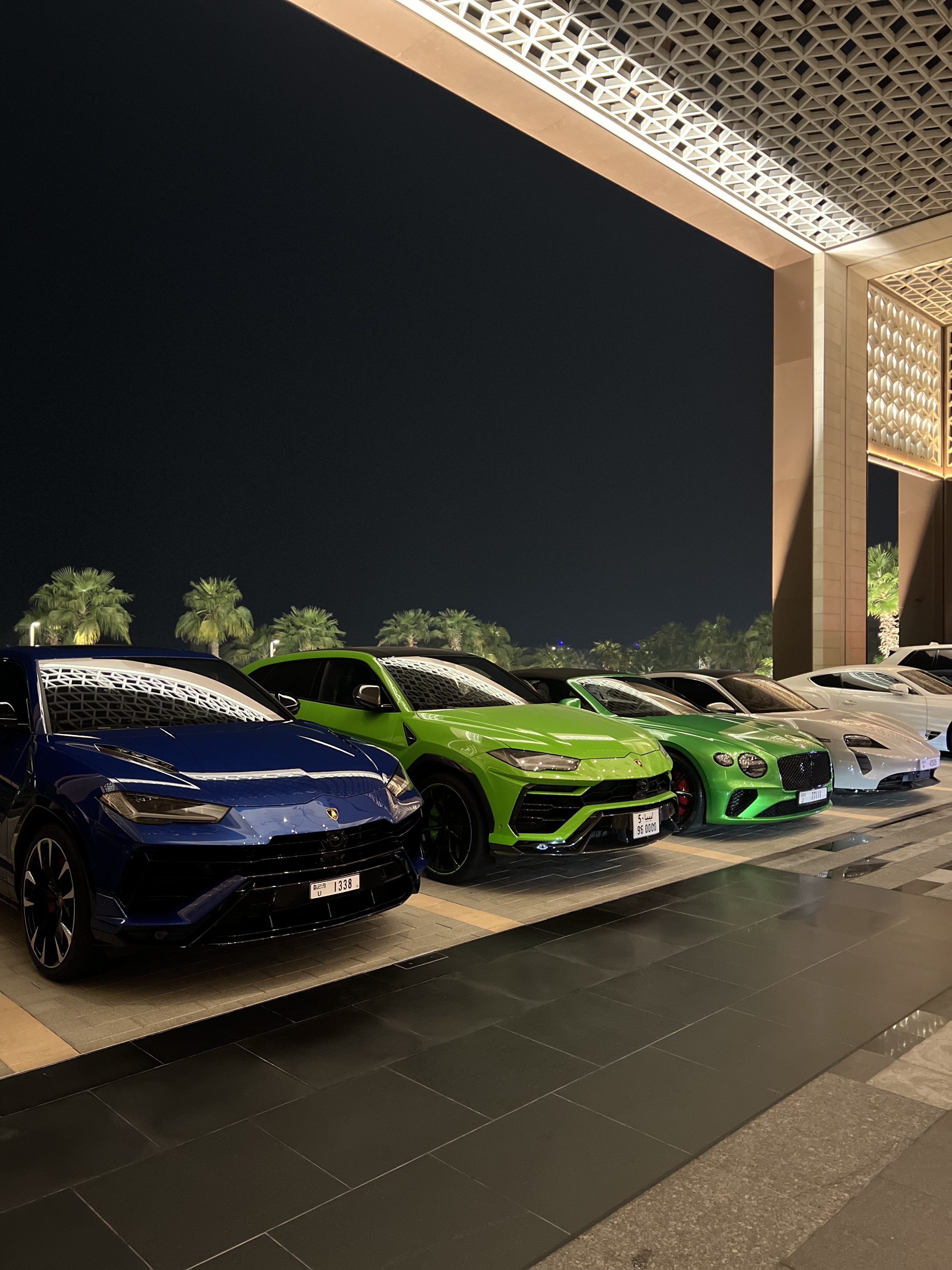
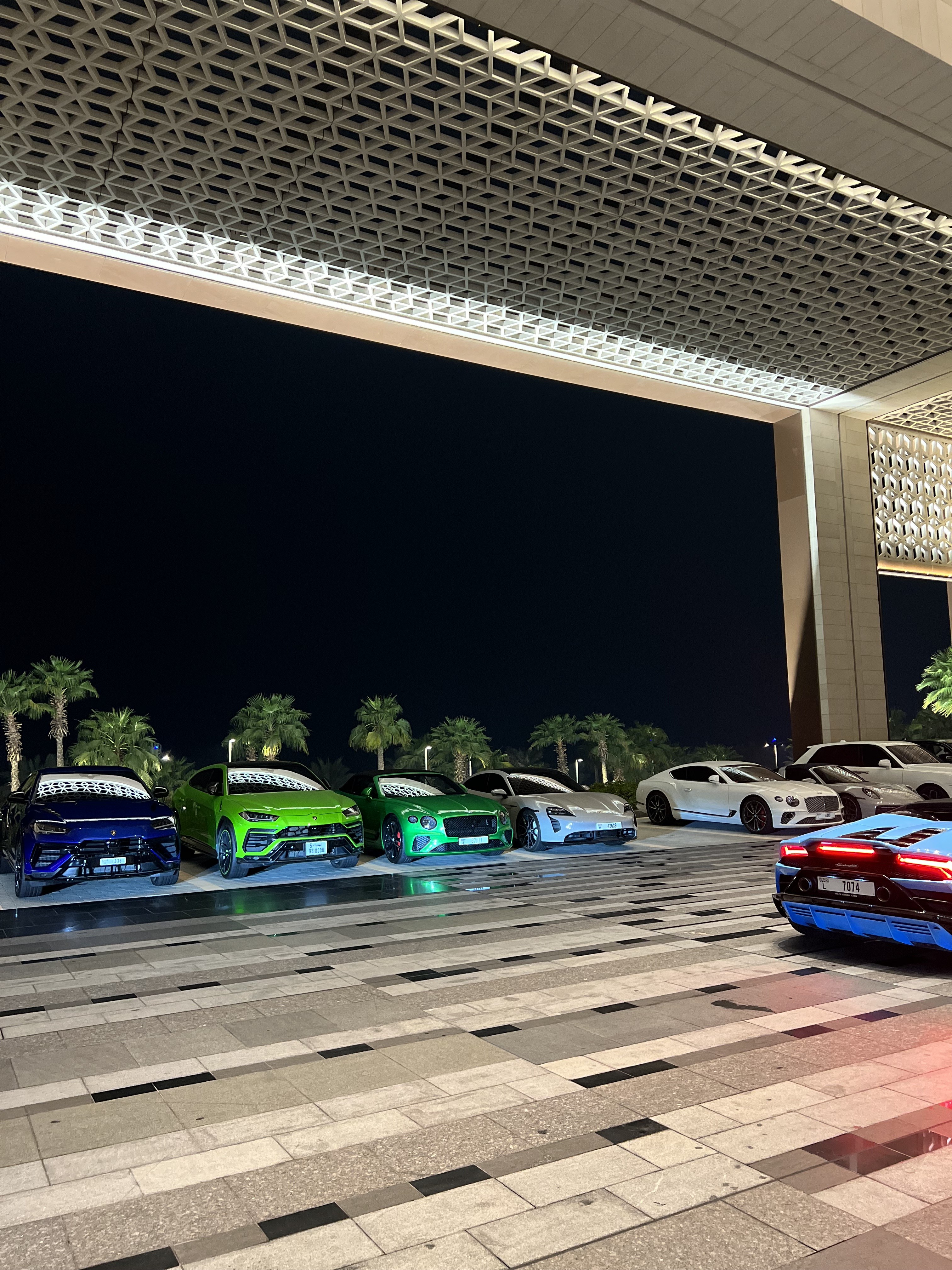
Under a geometric lattice canopy, a line of supercars stretches along the forecourt. Lamborghini, Bentley, the full primary palette against a black Dubai sky. They are placed, not simply parked. The arrangement reads as a display: colour chosen, spacing considered. The building above curves away into lit tiers. Atlantis The Royal announces its register at the threshold, before the doors open.
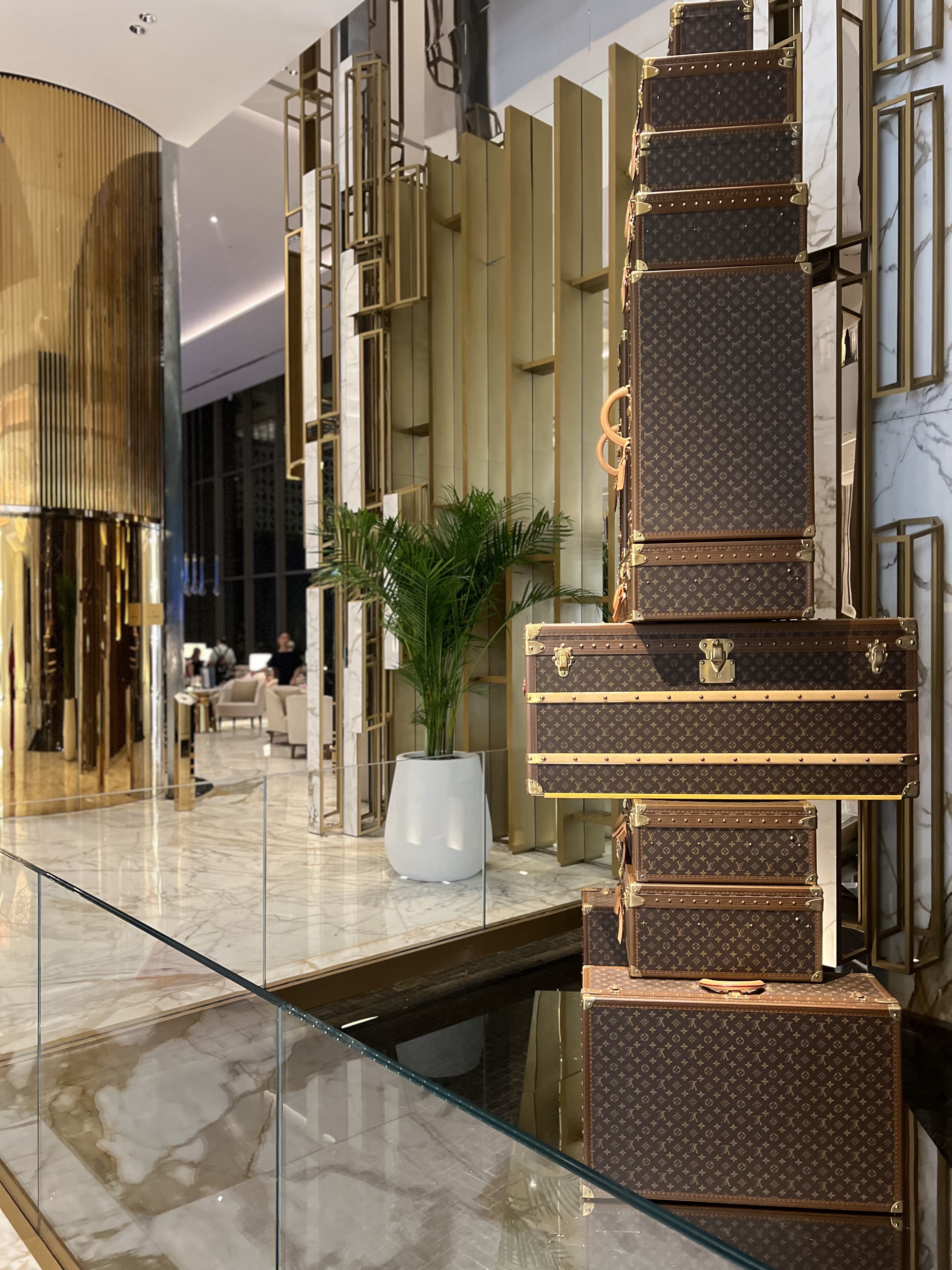
Inside, the lobby is calibrated to exceed expectation. Fluted gold columns rise from marble floors. A stack of Louis Vuitton trunks occupies a vitrine beside the corridor: the furniture of elsewhere, placed deliberately at the point of arrival. The scale is managed without apology.
The centre of the lobby holds two things at once.
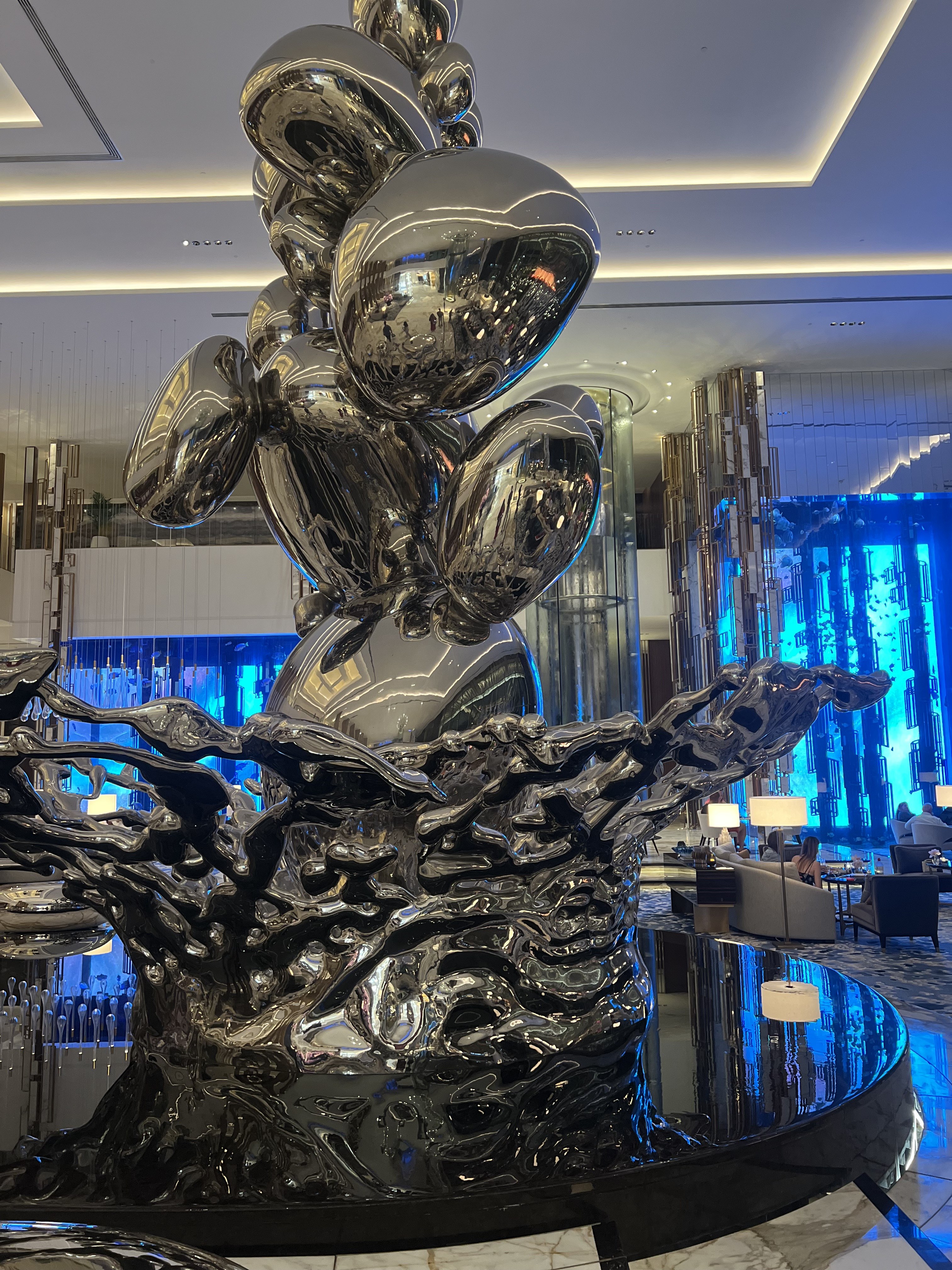
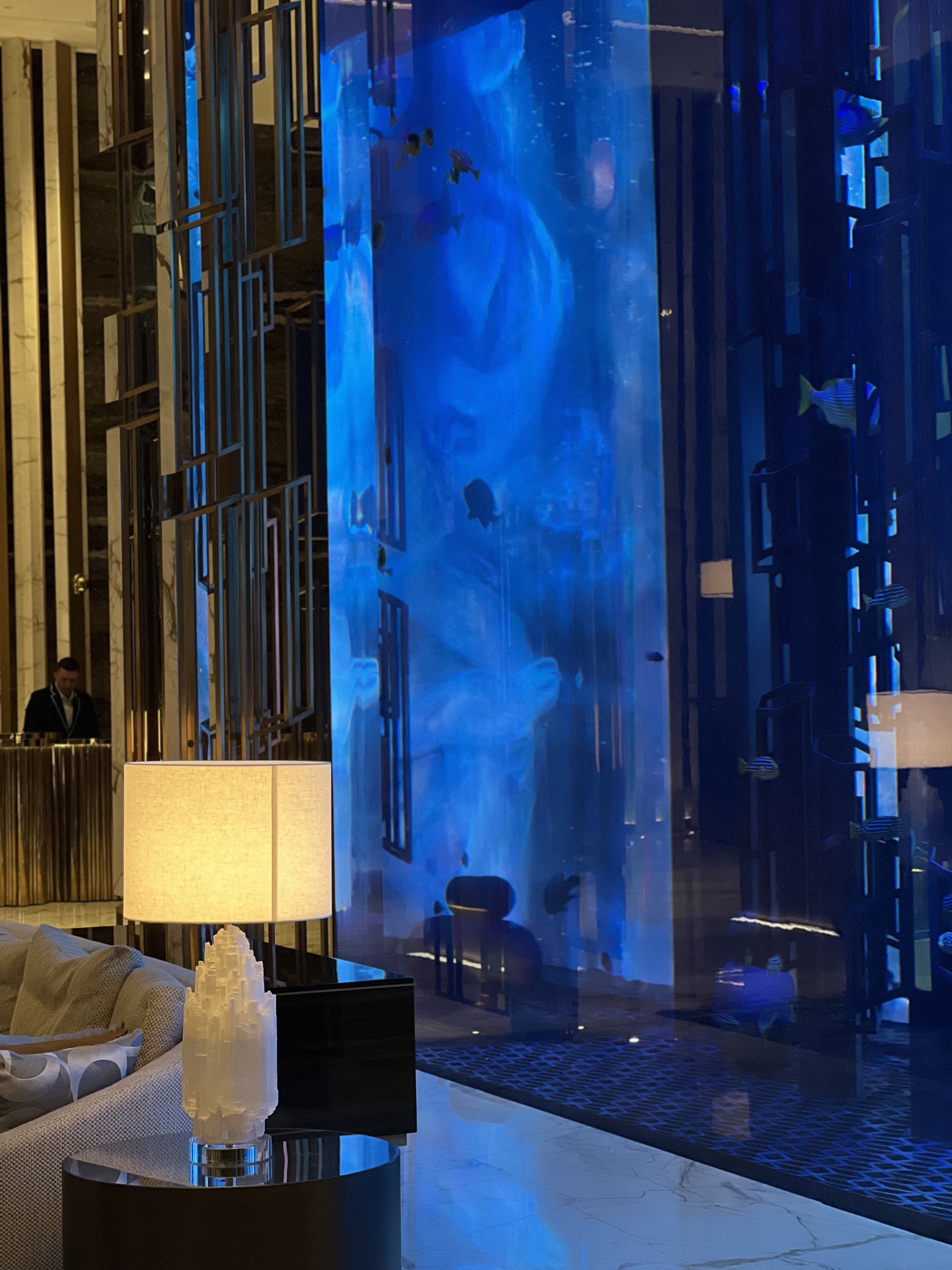
A large polished chrome sculpture rises from a black plinth, its surfaces bowed and reflective, the room caught and distorted across its form. Behind it, a floor-to-ceiling aquarium runs the full height of the space, fish moving slowly through deep blue light. The sculpture and the water operate on different registers: solid and liquid, dark and luminous. Together they give the lobby its focal point.
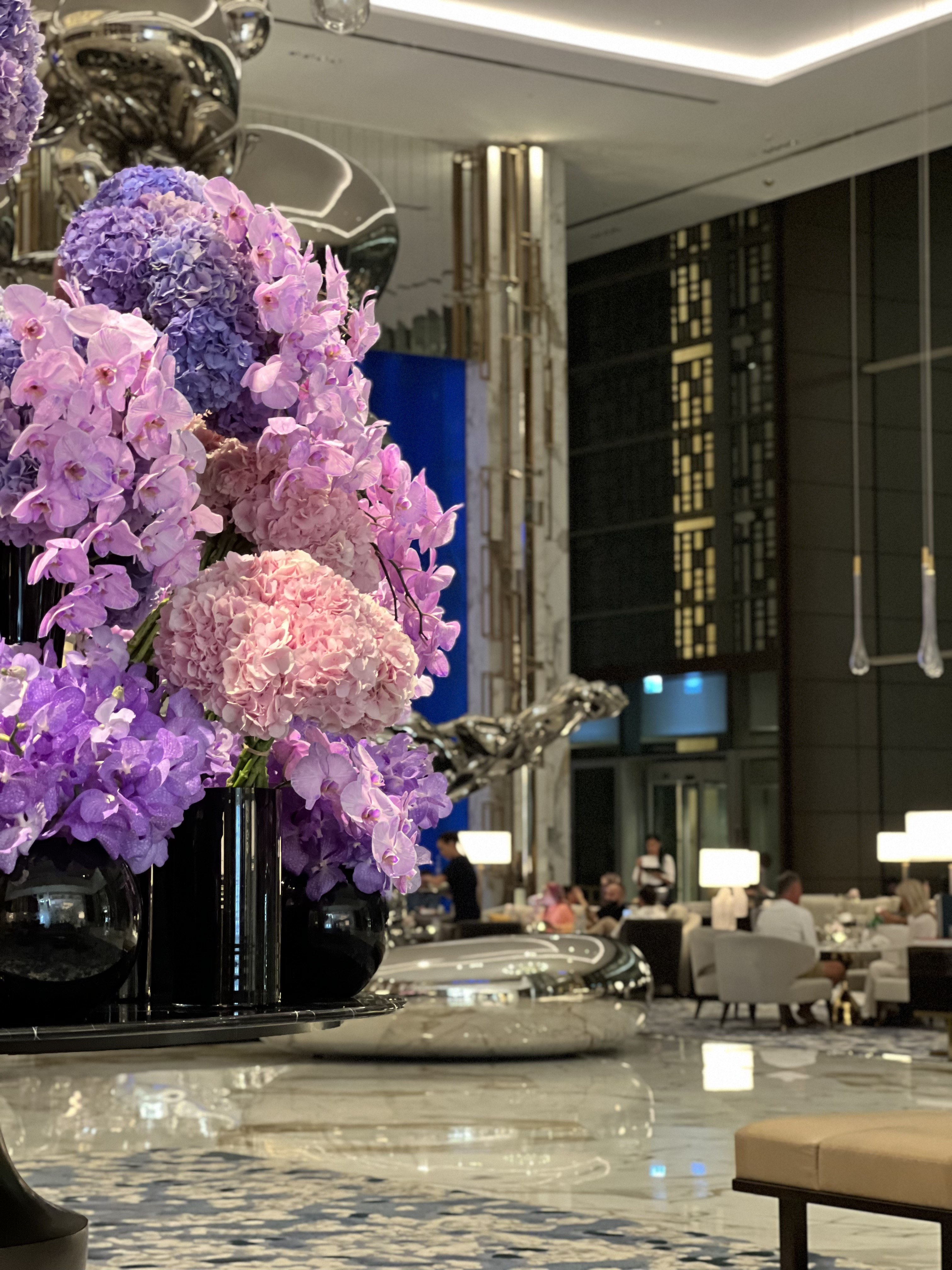
Elsewhere, a chandelier of glass teardrops descends from the ceiling above a large digital wall cycling through abstract imagery: vivid pink and violet washes, shifting slowly. Orchids in black vases at table level. A crystal mineral object on a side table beside the sofa. Each object placed with the knowledge that it will be seen.
At night, the building changes.
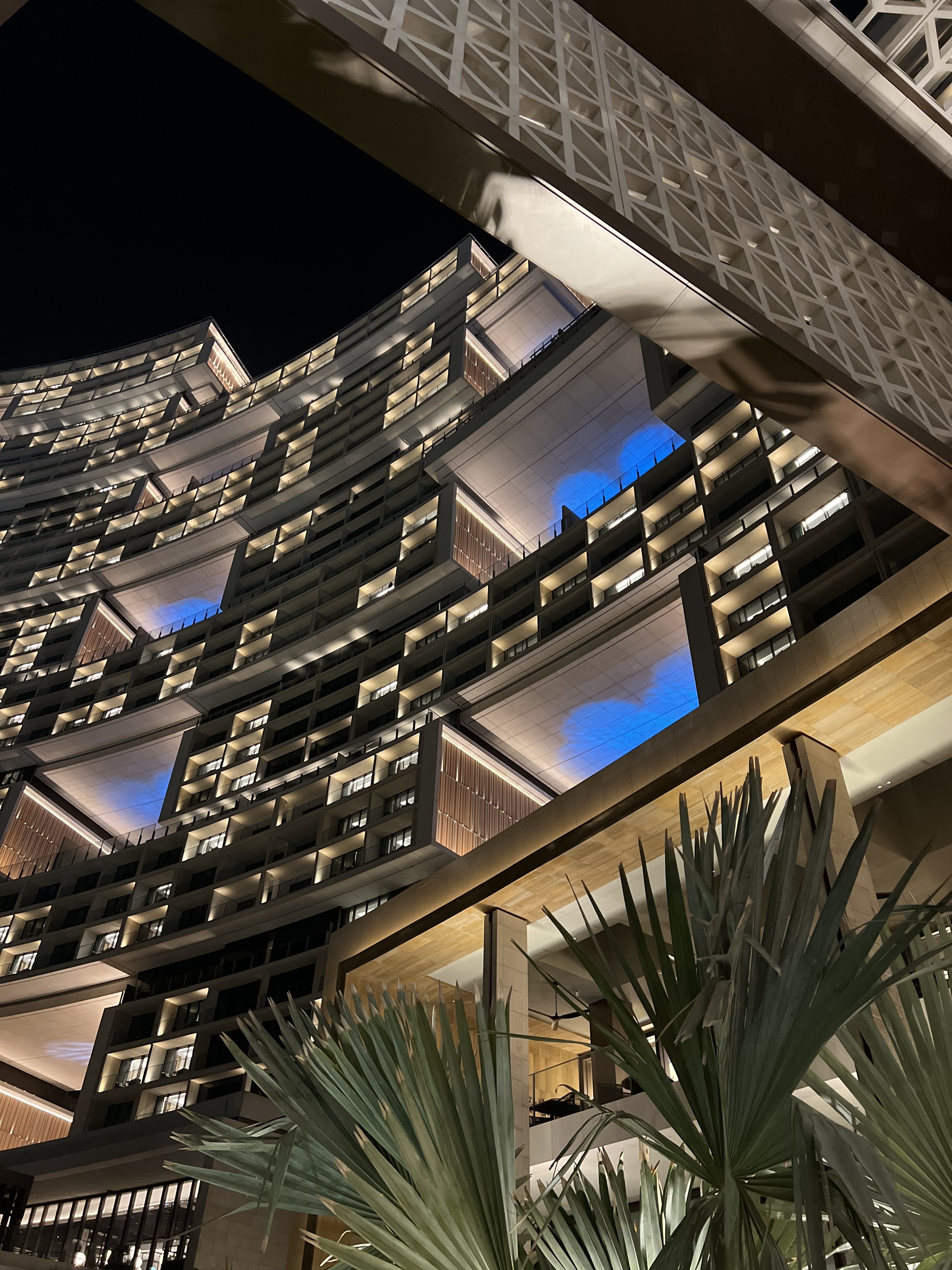
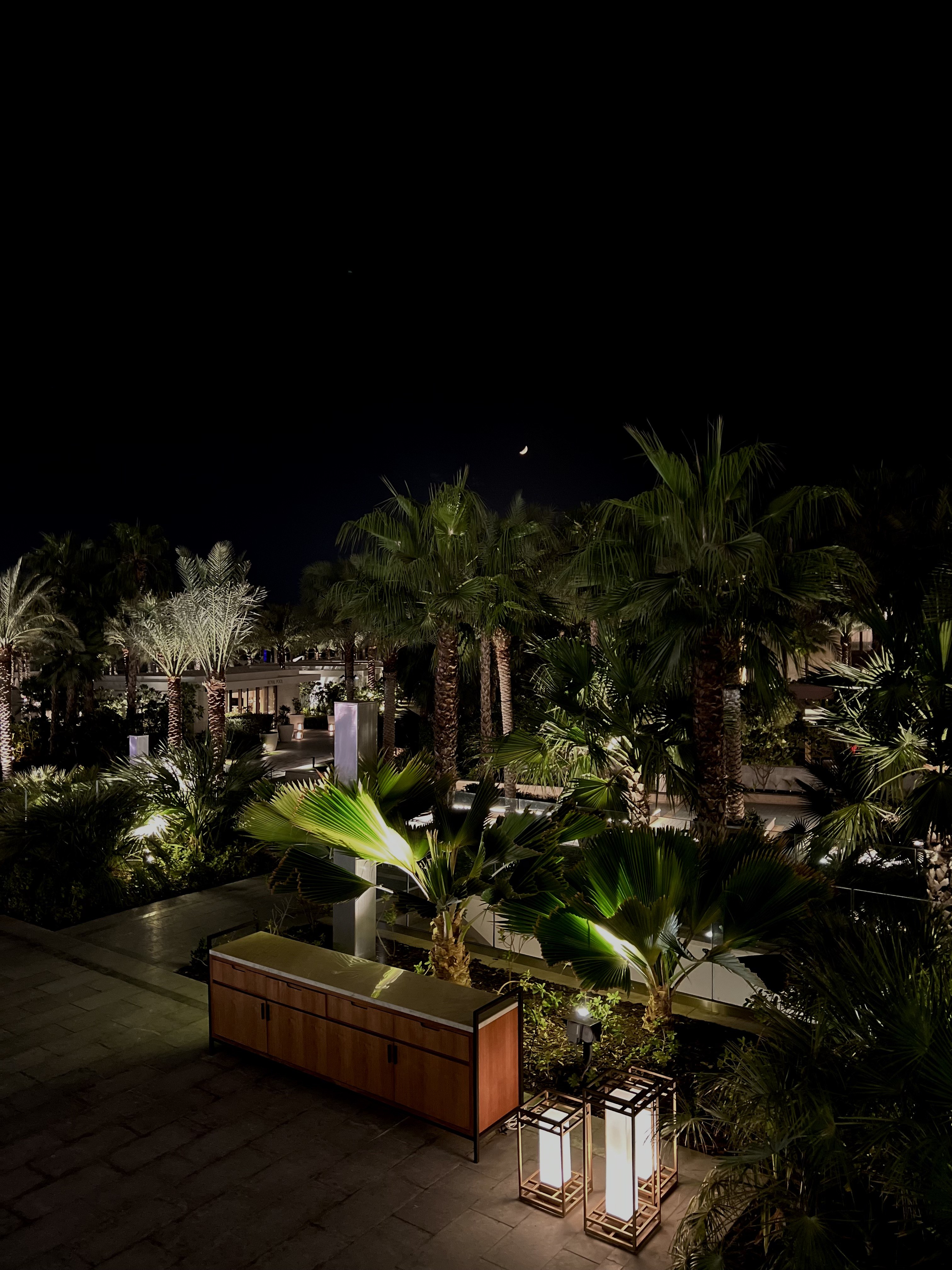
From below, the curved facade resolves into stacked balconies and lit horizontal fins, blue light washing the upper floors. The palm gardens between buildings carry a quieter atmosphere: uplighting from below, square lanterns at ground level, a crescent moon visible above the canopy. The grounds do not compete with the lobby.
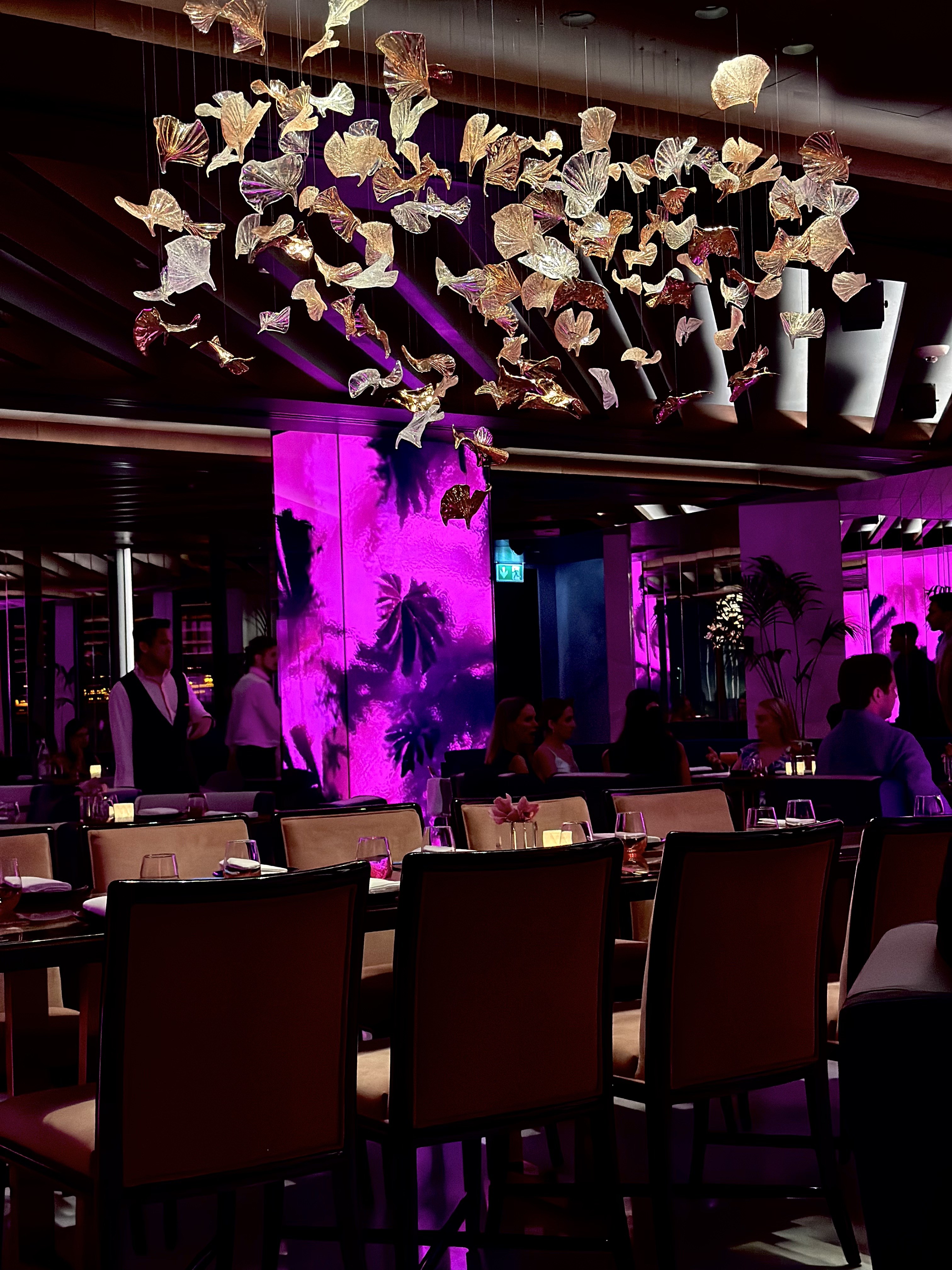
In the dining room, the register shifts entirely. Pink and magenta wash the space. Above the tables, a ceiling installation of white shell and fan forms hangs suspended. The setting is deliberate and theatrical. This is not a room that holds back.
This study is about the management of scale.
Atlantis The Royal operates at a size and register that would be difficult to hold together. The supercars at the entrance, the trunks in the lobby, the sculpture and the aquarium and the flowers and the chandelier: in isolation, any one of these would be notable. Together, they form a complete argument about what a certain kind of arrival should feel like.
For mkd STUDIO, Atlantis The Royal becomes a study in spectacle as hospitality language. A place where excess is held within form, where every object is placed with intent, and where the experience begins before you have crossed the threshold.
Atlantis The Royal opened on the outer crescent of Dubai's Palm Jumeirah in 2023, with a launch that included a private Beyoncé concert and a firework budget that made international news. It is a forty-three storey stack of shifted glass blocks holding some ninety pools, a beach club, restaurant floors run by celebrity chefs, and a general ambition that can be read from the airport road. The study takes the property on its own terms. There is no point photographing spectacle reluctantly; the honest questions are whether the spectacle is composed, and what it looks like at the level of detail.
The photographs were made at night, when the building is most legible: the tiers lit against the black Gulf sky, the supercars arranged on the forecourt like a display case, the geometric canopy sorting the arrival light into pattern. Attention stays on the evidence of arrangement, spacing, symmetry, the deliberate palette of the cars against the dark, because arrangement is where a property this loud either proves it is designed or reveals it is merely large.
Within an archive that mostly documents restraint, Atlantis The Royal serves as the calibrating extreme: the far end of hospitality's register, held to the same editorial standard as a quiet café in Manchester. The study's conclusion is in its frames rather than its captions, but it can be summarised: spectacle at this scale is not the absence of care. It is care, pointed outward, at maximum volume, and it photographs best when taken seriously.